
Official Release
To gain a comprehensive, systematic understanding of the current status and dynamic changes of wintering bird resources in Yancheng, and to provide scientific support for wetland conservation, migratory bird management and ecological development, the Yancheng Wetland and World Heritage Protection and Management Center conducted a citywide survey of wintering migratory birds from December 2025 to February 2026.

1. Survey Objectives
• To clarify the composition, population size and spatio‑temporal distribution of wintering birds in Yancheng.
• To monitor the population status and habitat use of rare, endangered and nationally protected species.
• To analyze community structure and diversity, identify key habitats, and assess major threats.
• To establish a long‑term monitoring database for scientific conservation and management.
2. Survey Scope
The entire administrative area of Yancheng City, with a focus on inland wetlands and coastal wetlands.
3. Survey Methods
• Line transect surveys
• Point count surveys
• Biodiversity analysis
• Data verification and cross‑checking
4. Results and Analysis
4.1 Species Composition and Population
During December 2025 – February 2026, three synchronous citywide surveys recorded:
• 151 bird species (17 orders, 48 families)
• Total population: >216,000 individuals
Waterbirds: 81 species, >208,000 individuals (96.2% of total)
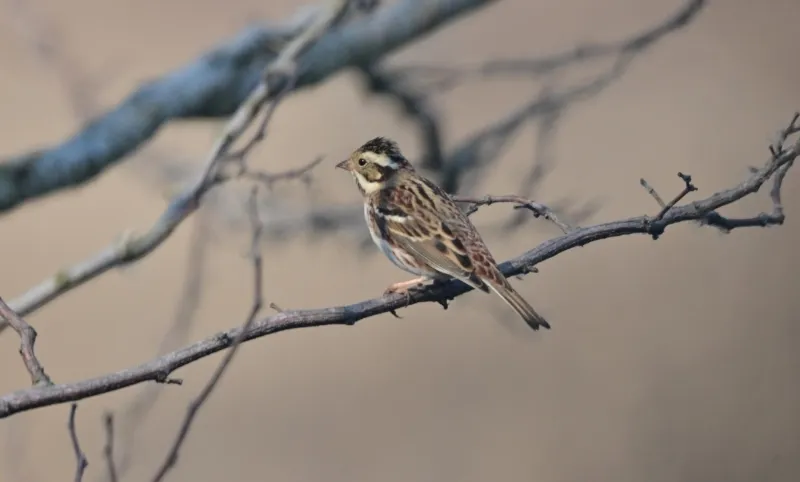
Terrestrial birds: 70 species, >8,400 individuals (3.9% of total)
Waterbirds dominate, confirming Yancheng’s importance as a key wintering wetland.
By residency status
• Wintering migrants: 118 species, >207,000 individuals (78.14% species, 95.9% individuals)
• Residents: 23 species, ~7,500 individuals (15.23% species, 3.5% individuals)
• Passage migrants: 10 species, ~1,200 individuals (6.62% species, 0.6% individuals)
Wintering migrants form the majority, highlighting Yancheng’s core position on the East Asian–Australasian Flyway.
Dominant groups
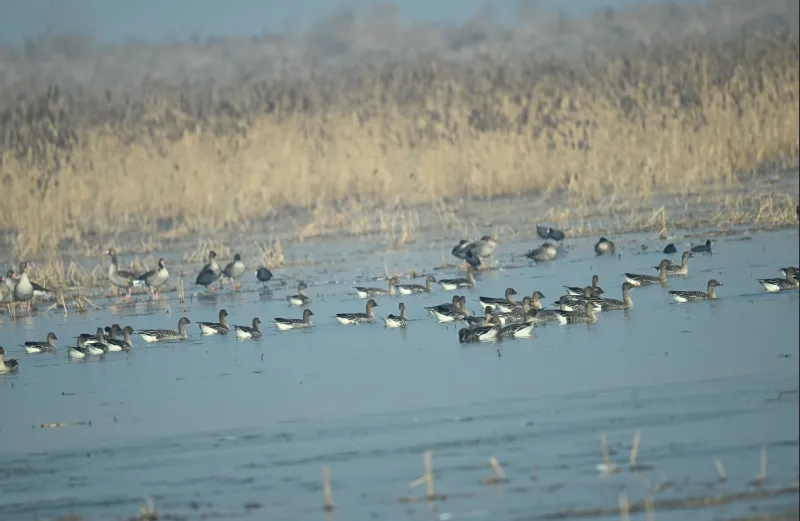
• Anatidae: 25 species, >87,000 individuals
• Cormorants: 1 species (Great Cormorant), >48,000 individuals
• Shorebirds (Charadriiformes): 18 species, >21,000 individuals
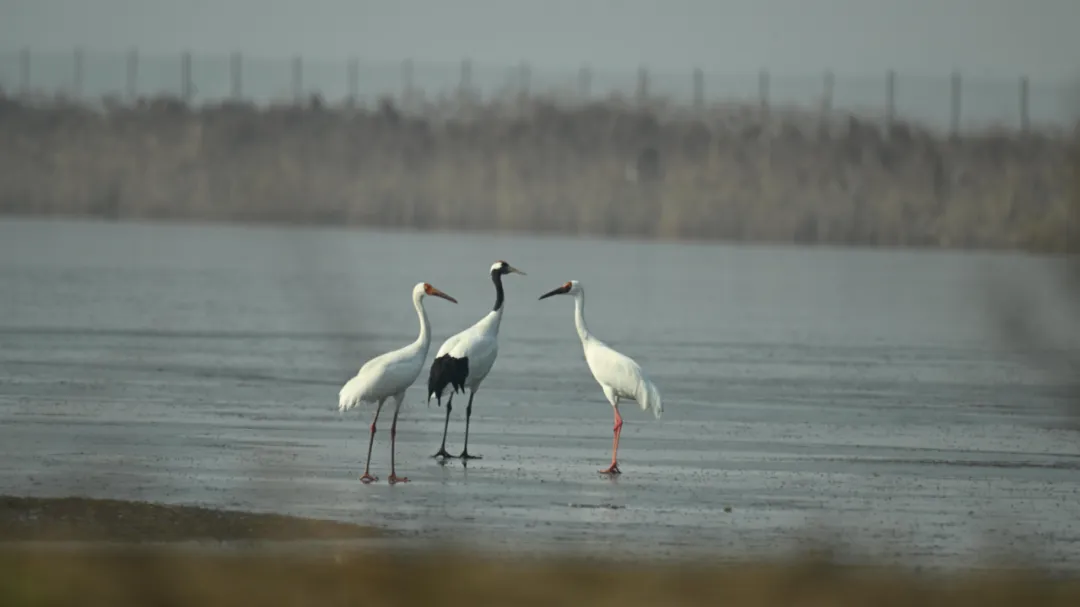
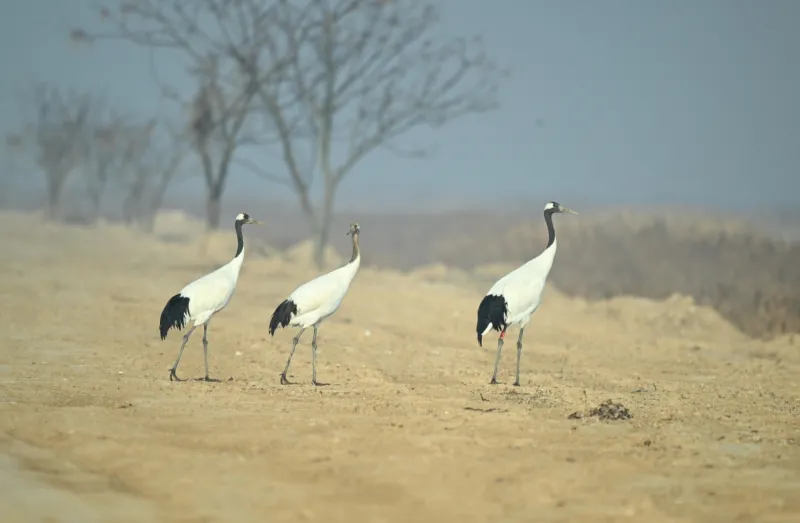
• Cranes: 6 species, ~3,700 individuals
These four groups account for 48.34% of species and 89.8% of individuals, shaping the winter bird community.
4.2 Rare and Endangered Species
IUCN Threatened Species (15 species, ~10,000 individuals)
• Critically Endangered (CR): Siberian Crane
• Endangered (EN): Oriental Stork, Crested Ibis, Far Eastern Curlew, Swan Goose
Vulnerable (VU): Black‑legged Kittiwake, White‑naped Crane, Hooded Crane, Curlew Sandpiper, Black‑faced Spoonbill, Sharp‑tailed Sandpiper, Red‑crowned Crane, Grey Plover, Common Pochard, Saunders's Gull
Nationally protected species (34 species, >12,800 individuals)
• Class I National Protected Birds (9 species, >900 individuals)
Oriental Stork, Red‑crowned Crane, Saunders's Gull, Siberian Crane, Hooded Crane, White‑naped Crane, Dalmatian Pelican, Black‑faced Spoonbill, Crested Ibis
• Class II National Protected Birds (25 species, >11,900 individuals)
Grey Crane, Eurasian Spoonbill, Common Merganser, Reed Parrotbill, Smew, Swan Goose, Greater White‑fronted Goose, etc.
Rare species populations remained stable overall, with slight increases in Dalmatian Pelican and Saunders's Gull.
4.3 Temporal Dynamics and Spatial Distribution
Temporal pattern
• December: population peak
• January: stable
• February: gradual decline
Waterbirds consistently >95% of total.
Spatial pattern
• Coastal > inland
• Northern > southern
• Natural and artificial wetlands complementary
4.4 Species Meeting the 1% Global Population Threshold
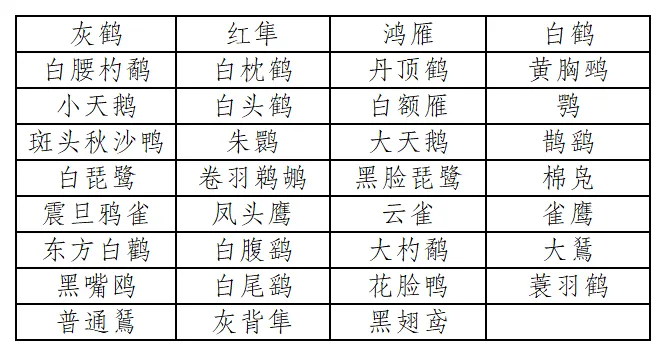
In line with Ramsar criteria for Wetlands of International Importance, 31 waterbird species met the 1% global population threshold. These species are concentrated in key coastal protected areas, demonstrating high habitat quality and effective conservation.
5. Conclusion
The 2025–2026 wintering bird survey confirms that Yancheng’s wetland ecosystem is stable, diverse and well‑functioning. The city serves as a core hub on the East Asian–Australasian Flyway, providing critical wintering and stopover habitat for global waterbird populations.